

Deep within the vast grasslands of North America, a sophisticated communication network operates among some of the prairie’s smallest inhabitants. Prairie dogs, those diminutive yet highly social rodents, possess one of the most complex vocal languages documented in the animal kingdom. While they may appear to be simply chirping and barking as they stand sentinel at their burrow entrances, scientists have discovered these creatures are actually engaging in remarkably detailed conversations. Their communication system includes specific alarm calls that identify different predators, territorial announcements, and even social greetings that maintain community bonds. This article explores the fascinating and intricate world of prairie dog communication – a hidden language that has evolved over millennia and continues to surprise researchers with its complexity and precision.
The Prairie Dog: More Than Just A Rodent

Prairie dogs are colonial, burrowing rodents native to the grasslands of North America, belonging to the genus Cynomys. Despite their name, these animals are not canines but rather members of the squirrel family Sciuridae. Five species exist across the continent: black-tailed, white-tailed, Gunnison’s, Utah, and Mexican prairie dogs. These highly social creatures live in complex underground tunnel systems called “towns” or “colonies” that can span hundreds of acres and house thousands of individuals. Their sophisticated social structure requires equally sophisticated communication methods to coordinate activities, warn of dangers, and maintain social bonds. The intelligence of prairie dogs is often underestimated, as evidenced by their ability to transmit specific and detailed information through their vocalizations and body language.
The Acoustic Arsenal: Types of Prairie Dog Calls
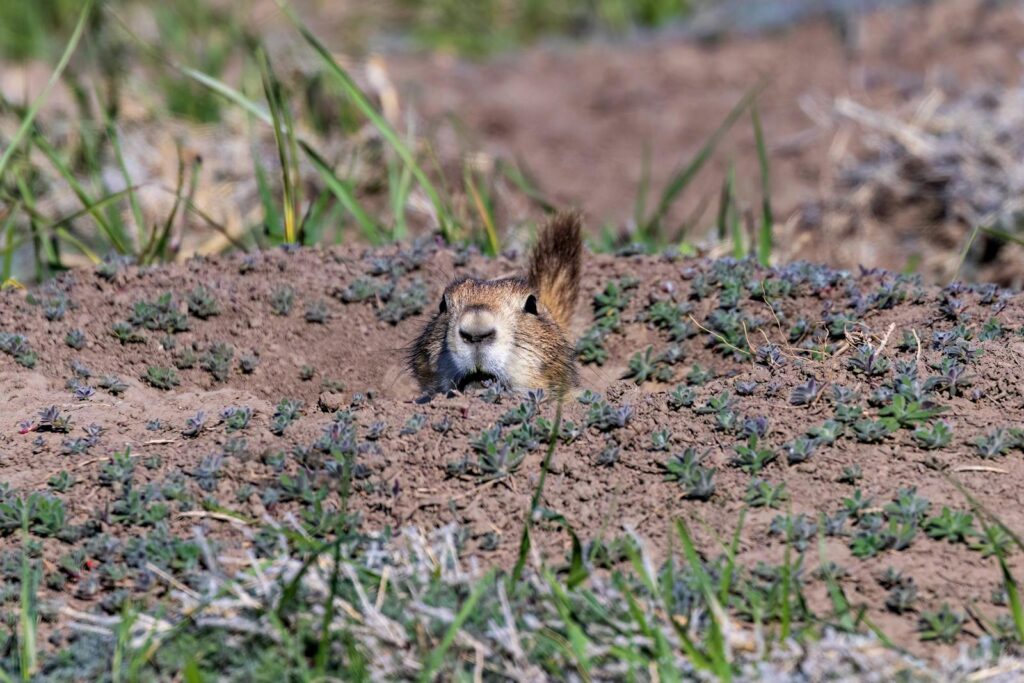
Prairie dogs utilize a diverse repertoire of vocalizations to convey different messages within their communities. The most famous is their alarm call, often described as a high-pitched “bark” that gives them their name – early settlers thought these sounds resembled a dog’s bark. Beyond these alarm calls, researchers have identified at least ten distinct call types including greeting chirps, territorial calls, distress calls, and warning barks. Each call type serves a specific purpose within their social structure. Some calls are used to identify individual prairie dogs, while others coordinate group activities like foraging. The acoustic properties of these vocalizations vary significantly in pitch, duration, and pattern, creating a complex auditory language that carries surprisingly detailed information.
Predator-Specific Alarm Calls: Nature’s Descriptive Language

One of the most remarkable aspects of prairie dog communication is their ability to describe specific predators through their alarm calls. Groundbreaking research by Dr. Con Slobodchikoff of Northern Arizona University revealed that prairie dogs don’t simply have a general alarm call – they have specific calls for different predator types. These calls contain information about the predator’s species (hawk, coyote, human, domestic dog), size, shape, color, and even the speed at which the threat is approaching. When researchers played back recordings of these alarm calls to prairie dog colonies, the animals responded appropriately to the specific threat described – taking cover underground for aerial predators or standing alert at burrow entrances for terrestrial threats. This level of descriptive detail in animal communication has few parallels in the natural world and represents a form of primitive syntax.
The Human Identifier: How Prairie Dogs Describe Us

Among the most fascinating discoveries in prairie dog communication research is their ability to create specific alarm calls for individual humans. Studies have shown that prairie dogs can distinguish between different people and will use consistent, specific calls to identify the same person on separate occasions. These calls even change based on what the person is wearing or carrying, suggesting prairie dogs observe and catalog details about potential threats. In controlled experiments, prairie dogs created different alarm calls for people wearing different colored shirts, demonstrating their attention to visual details. Perhaps most remarkably, prairie dogs can remember and recognize specific humans for extended periods, using the same identifier call when a particular person returns to their colony after weeks or even months away.
The Visual Component: Body Language and Physical Displays

While vocal communication receives the most scientific attention, prairie dogs also employ an elaborate system of visual signals to convey information. The most recognizable is the “jump-yip” display, where a prairie dog stretches upward, throws its forelimbs into the air, and emits a high-pitched “yip” sound. This behavior, once thought to be simply an all-clear signal, is now understood to be a complex social display that helps maintain group cohesion and vigilance. Other visual signals include tail-flicking, which can indicate agitation or serve as a warning, and various postures that communicate readiness to fight, submission, or romantic interest. These physical displays work in conjunction with vocalizations to create a multi-channel communication system that conveys nuanced messages throughout the colony.
Dialects and Regional Variations: Prairie Dog Accents

Just as human languages develop regional dialects, prairie dog communication shows distinct variations between different colonies and geographic areas. Research has documented clear differences in the acoustic structure of calls between prairie dog towns, even when those towns are separated by relatively short distances. These “dialects” develop as colonies become isolated from each other and their communication patterns evolve independently. The differences can be so pronounced that prairie dogs from different regions may have difficulty understanding each other’s signals. These dialectical variations suggest a cultural component to prairie dog communication, where specific call patterns are learned rather than purely instinctual. The existence of these regional variations provides evidence that prairie dog communication has elements of a true language with learned components.
Kiss-Squeak Greetings: Social Bonding Through Communication

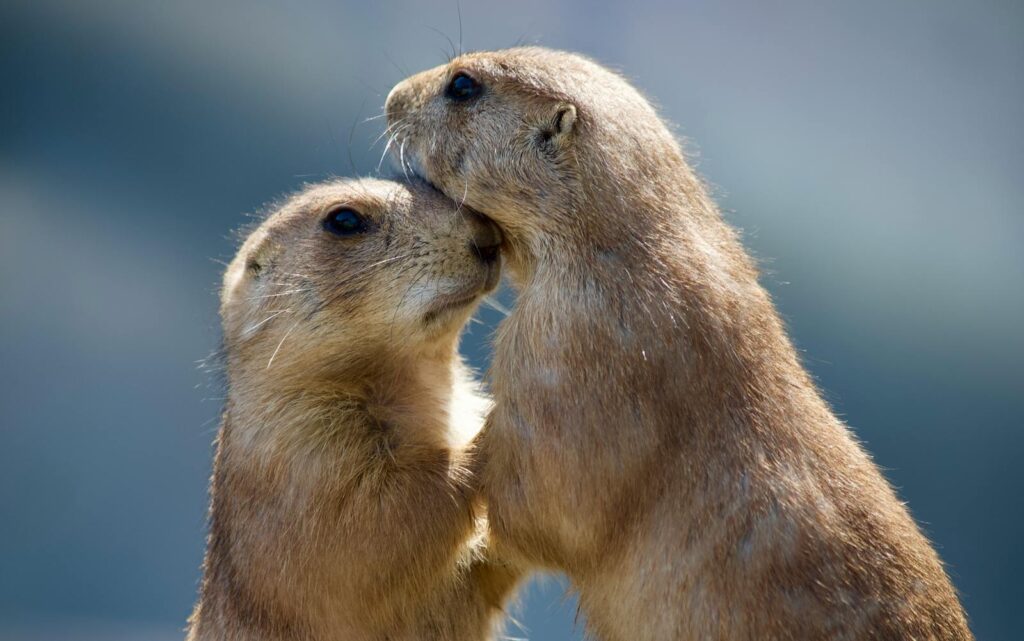
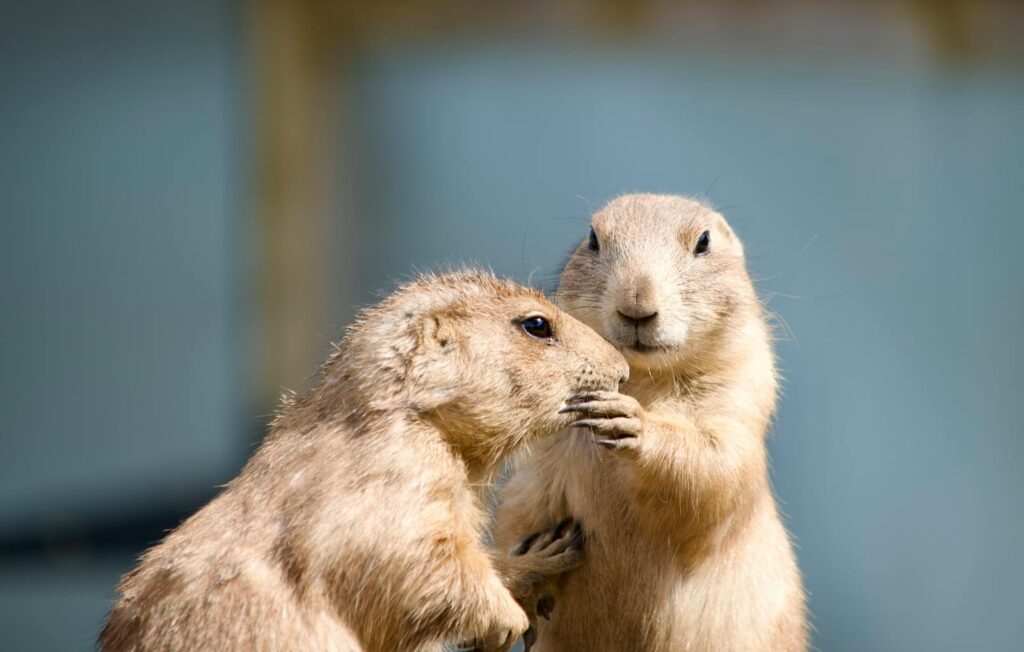
Prairie dogs maintain their complex social networks partly through ritualized greeting behaviors that include specific vocalizations. When colony members encounter each other, particularly after a period of separation, they engage in what researchers call the “kiss-squeak” greeting. This interaction involves two prairie dogs approaching face-to-face, touching their teeth together, and emitting a soft squeaking sound. This behavior serves multiple purposes beyond simple recognition. The kiss-squeak helps prairie dogs identify family members through scent and sound, reinforces social bonds within the family group, and can defuse potential aggressive encounters. These greeting rituals are especially important in maintaining the cohesion of the coterie – the basic family unit of prairie dog society typically consisting of one male, several females, and their offspring.
Territorial Announcements: Setting Boundaries Through Sound
Prairie dogs are highly territorial animals that defend their burrow systems and surrounding foraging areas from encroachment by unrelated individuals. Vocal communication plays a central role in establishing and maintaining these territorial boundaries. Male prairie dogs regularly emit specific territorial calls that announce their ownership of a particular area and warn potential intruders to stay away. These territorial vocalizations often occur at the boundaries between adjacent family groups’ territories and increase in frequency during breeding season when competition for resources and mates intensifies. The territorial calls contain information about the caller’s identity, size, and status within the colony hierarchy. Female prairie dogs also participate in territorial defense and have their own specific vocalizations that contribute to the demarcation of family boundaries.
The Cognitive Underpinnings: Prairie Dog Brain and Language

The sophisticated communication abilities of prairie dogs raise intriguing questions about their cognitive capabilities and neural processes. While their brains are small compared to primates, prairie dogs have well-developed regions associated with social behavior and vocal production. Their neocortex – the brain region associated with higher functions like sensory perception and language in humans – is proportionally large for a rodent. Neurological studies suggest prairie dogs possess specialized brain structures that allow them to both produce and interpret their complex vocalizations. Research using functional imaging techniques has shown increased activity in specific brain regions when prairie dogs hear alarm calls, with different patterns of activation for different predator calls. These findings indicate that prairie dogs have evolved specialized neural machinery to support their elaborate communication system.
Communication Development: How Young Prairie Dogs Learn to Talk
The acquisition of communication skills in young prairie dogs provides further evidence of the sophisticated nature of their vocal system. Juvenile prairie dogs don’t emerge from their natal burrows until they’re about six weeks old, and when they first appear above ground, their communication abilities are limited. Young prairie dogs go through a learning period during which they acquire the specific alarm calls and social vocalizations used by their colony. Initially, they may produce generalized alarm calls that lack the specificity of adult vocalizations. Through observation of adults and social interaction, they gradually refine their calls to match the dialect of their colony. This learning process takes several months and involves significant trial and error as juveniles practice distinguishing between different threats and producing the appropriate response. The presence of this learning period suggests that prairie dog communication has both innate and learned components.
Scientific Methods: How Researchers Decode Prairie Dog Talk

Deciphering the complexities of prairie dog communication has required innovative research methodologies developed over decades of field studies. Early research relied primarily on observational techniques, with scientists cataloging behaviors and associated vocalizations. Modern studies employ sophisticated audio recording equipment that can capture the high-frequency components of prairie dog calls inaudible to human ears. Computer analysis of these recordings using spectrograms and waveform analysis allows researchers to identify subtle variations in call structure. Some groundbreaking studies have used experimental approaches where researchers present different stimuli to prairie dog colonies while recording their responses. For example, researchers have used differently colored shirts, different human individuals, or model predators to elicit specific alarm calls. The most advanced research employs machine learning algorithms to analyze patterns in prairie dog vocalizations and correlate them with specific stimuli or contexts.
Conservation Implications: Protecting Prairie Dog Communication Networks

The complex communication systems of prairie dogs highlight the importance of preserving not just individual animals but entire colonies and their social structures. When prairie dog populations are fragmented by development, agriculture, or extermination programs, the sophisticated communication networks they’ve evolved over millennia are disrupted. Small, isolated colonies lack the collective vigilance that larger groups maintain through their communication system, making them more vulnerable to predation. Additionally, the development of regional dialects means that when prairie dogs are relocated or colonies merged for conservation purposes, communication barriers may arise. Conservation strategies increasingly recognize the need to preserve large, connected prairie dog colonies that can maintain their social complexity and communication networks. Understanding prairie dog communication also helps scientists monitor colony health and stress levels, as changes in communication patterns often signal environmental pressures or disease.
Future Research: The Evolving Understanding of Prairie Dog Language

The field of prairie dog communication research continues to evolve with new technologies and research approaches opening exciting frontiers. Current research directions include using artificial intelligence to further decode the subtleties of prairie dog vocalizations and potentially develop a more complete “dictionary” of their communication system. Some researchers are exploring the possibility of using playback experiments to effectively “talk” to prairie dogs by broadcasting synthesized calls and observing responses. Another promising area involves comparing prairie dog communication with that of other highly social rodents to understand how complex communication systems evolve. Neurobiological studies using non-invasive imaging techniques may help reveal more about how prairie dog brains process and produce their sophisticated vocalizations. As our understanding deepens, prairie dogs continue to challenge our assumptions about the cognitive and communicative capabilities of non-primate species.
The remarkable communication abilities of prairie dogs offer a window into the complex social lives of these often underappreciated animals. Far from simple rodents, prairie dogs have evolved one of the most sophisticated animal communication systems known to science – complete with predator descriptions, individual recognition, regional dialects, and social rituals. Their ability to convey specific information about their environment challenges traditional boundaries between animal communication and human language. As research continues to unlock the secrets of prairie dog “conversations,” we gain not only scientific knowledge but also a deeper appreciation for the intelligence and social complexity of these grassland sentinels. In their chirps, barks, and physical displays, prairie dogs remind us that complex communication exists throughout the animal kingdom, often in species and places where we least expect to find it.